


Dust explosion prevention technology
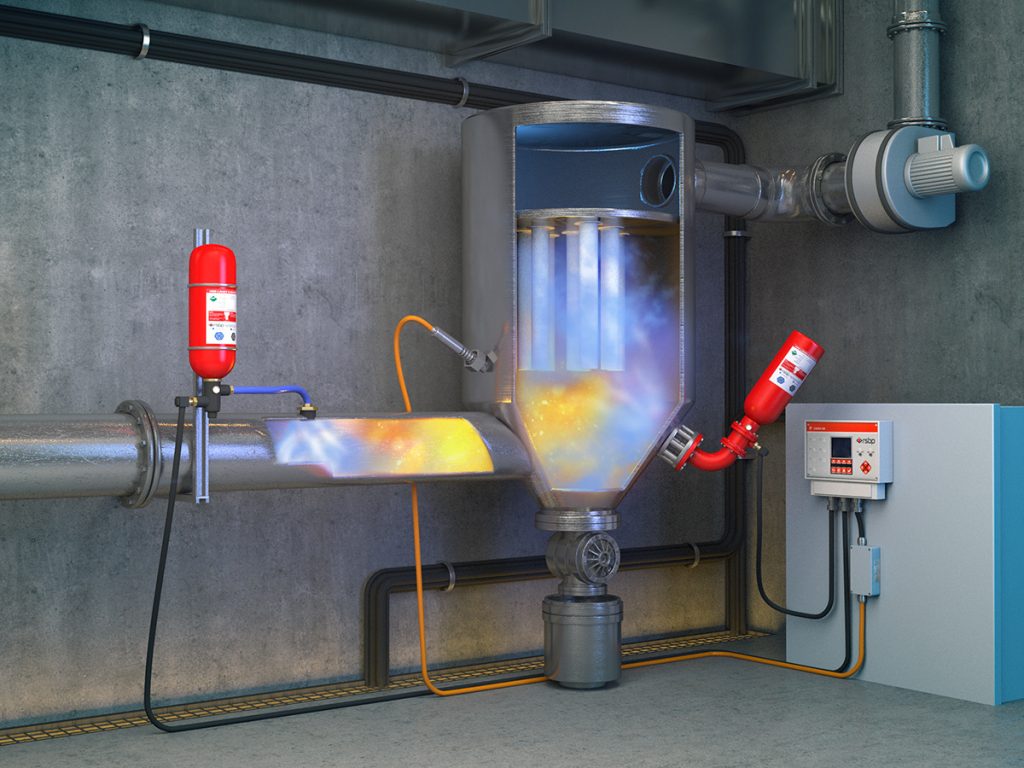
Dust explosion refers to a chemical reaction in which combustible dust, mixed with an oxidizing gas (such as oxygen or air) to form a dust cloud within a confined space, rapidly burns in the presence of an ignition source, causing a rapid increase in temperature and pressure.
The conditions for a dust explosion generally include five factors:
(1) The presence of dust that can undergo an oxidation reaction with an oxidizing gas;
(2) The presence of an oxidizing gas;
(3) The presence of a high-temperature heat source sufficient to ignite the dust, i.e., an ignition source;
(4) The dust is suspended in the oxidizing gas, forming a dust cloud, and reaching the lower explosive limit;
(5) The dust cloud is confined within a relatively enclosed space.
Dust Explosion Control Technologies
(1) Explosion-Proofing
This involves strengthening equipment and facilities to withstand a certain explosion pressure, thereby preventing equipment damage. For dust explosion-proof design, the design pressure is generally around 1.0 MPa, based on the maximum explosion pressure of approximately 0.9 MPa in a 20L sphere. However, most dust collectors currently have a pressure rating of only 30-50 kPa, so explosion venting needs to be considered.
(2) Explosion Venting
This involves installing pressure relief devices, such as rupture discs and pressure relief doors, on equipment and facilities to allow the rapid release of explosion pressure, reducing the peak pressure inside the equipment and thus minimizing the harm to equipment and personnel. Explosion venting devices need to be rationally designed and arranged according to the characteristics of the equipment and the working environment, taking into account the amplifying effect of internal turbulence in dust collectors and fluidized beds on dust explosions. It is worth noting that explosion venting can only reduce the maximum explosion pressure in the container and prevent container damage; it cannot prevent the flame of the dust explosion from spreading to other containers through pipes.
(3) Explosion Isolation
This involves setting up explosion isolation valves or suppressors to isolate the explosion area from other areas, preventing the explosion from affecting the entire system. This method is often used in complex piping and equipment systems to ensure that if an explosion occurs, the impact can be controlled within the smallest possible range.
(4) Explosion Suppression
Explosion suppression is also an effective method to reduce the explosion pressure inside a container. In the early stages of an explosion, a suppressant (such as a fire extinguishing agent or gas) is rapidly injected to inhibit the propagation and development of the explosion. Explosion suppression systems are usually equipped with sensors and automatic control devices that can activate the suppressant injection the moment an explosion signal is detected, thereby effectively controlling the explosion.