


What are the types of powder grinding equipment, and what are their advantages and disadvantages?
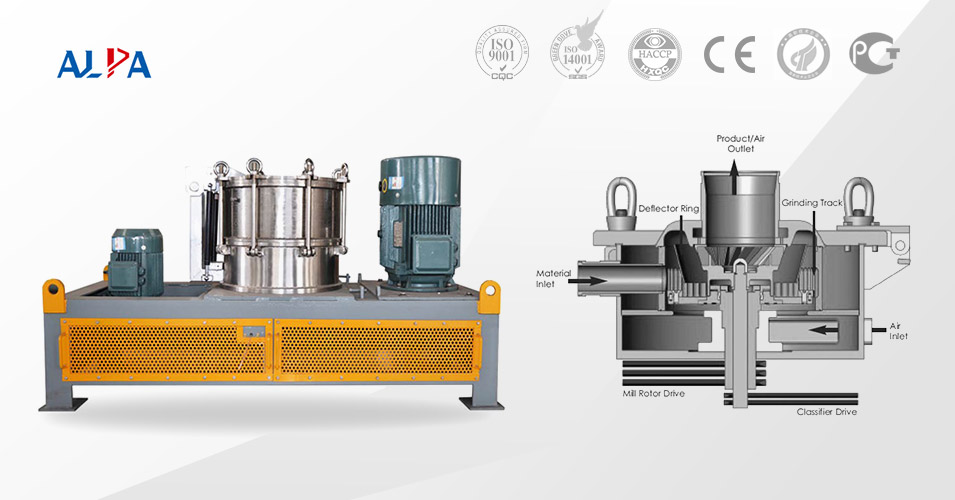
In industrial production, powder crushing is a fundamental and crucial process. Whether in the chemical, pharmaceutical, food, or mining industries, efficient crushing equipment is indispensable. Choosing the right crushing equipment can not only improve production efficiency but also optimize product quality. So, what are the common types of powder crushing equipment? What are their respective advantages and disadvantages? And in which scenarios are they suitable?
Powder crushing equipment comes in many varieties. Based on their working principles and applications, they can be broadly classified into the following categories:
1. Jaw Crusher
A jaw crusher is a common coarse crushing device that crushes materials through the squeezing action between a moving jaw and a stationary jaw. It has a simple structure and is suitable for materials with high hardness, such as ores and rocks.
Simple in structure, easy to maintain, and with a large processing capacity, it is suitable for coarse crushing of high-hardness materials.
The product particle size is relatively coarse, energy consumption is relatively high, and noise and vibration are relatively large.
2. Hammer Crusher
A hammer crusher uses high-speed rotating hammers to impact and crush materials. This equipment is suitable for medium-hardness and brittle materials, such as limestone and coal.
High crushing ratio, high output, suitable for medium-hard materials.
However, the hammers wear out relatively quickly, making it unsuitable for high-hardness materials, and it generates significant dust pollution.
3. Ball Mill
A ball mill crushes materials to the micron level through the impact and grinding action of steel or ceramic balls inside the mill. It is widely used in the mining, building materials, and chemical industries.
Fine particle size, suitable for various materials, can be processed dry or wet.
High energy consumption, large equipment size, grinding media easily abrades materials.
4. Air Jet Mill
An air jet mill uses a high-speed airflow to drive material collisions, achieving ultrafine grinding. This equipment is suitable for materials with high hardness and high purity, such as ceramic powder and pharmaceutical raw materials.
The product has uniform particle size and is pollution-free, making it suitable for ultrafine grinding of high-purity materials.
The equipment is costly and energy-intensive, making it suitable for small-batch production.
5. Vibratory Mill
A vibratory mill pulverizes materials through the combined action of high-frequency vibration and grinding media, suitable for fine grinding and mixing processes.
It boasts high grinding efficiency and a narrow particle size distribution, making it suitable for fine grinding and mixing.
However, the equipment has a complex structure and high maintenance costs.
6. Roller Mill
A roller crusher uses two opposing rotating rollers to compress materials, suitable for medium and fine crushing, and commonly used in the cement and metallurgical industries.
Particle size is controllable, energy consumption is low, and it is suitable for medium and fine crushing.
However, it has poor adaptability to moist and sticky materials, and the roller surface is prone to wear.
Selection of powder equipment
Mining Industry
Jaw crushers and ball mills are common choices in ore crushing and beneficiation. Jaw crushers are used for coarse crushing, while ball mills are used for fine grinding, ensuring the ore reaches the particle size required for subsequent processes.
Chemical Industry
Chemical raw materials typically require high purity and fineness. Air jet mills and vibratory mills can meet their needs for ultrafine powders while avoiding contamination.
Pharmaceutical and Food Industries
These industries have extremely high requirements for hygiene and safety. Air jet mills and vibratory mills are preferred due to their pollution-free and easy-to-clean characteristics. For example, air jet milling technology is often used for pulverizing pharmaceutical raw materials and food additives.
Building Materials Industry
The production of building materials such as cement and lime requires a large number of medium and fine crushing equipment. Roller crushers and hammer crushers are widely used due to their high output and low energy consumption.
New Materials Industry
With the development of new materials technology, the requirements for powder particle size and morphology are becoming increasingly stringent. Air jet mills and ball mills play an important role in the preparation of ceramic powders and metal powders.